How to take meeting minutes without typing during the meeting
Typing minutes means missing half the meeting. A practical approach to recording, summarising and getting action items out — with who owes what.
The problem with typing minutes
Whoever takes the minutes is the person paying least attention. They are transcribing the sentence that just finished while the next one goes past, and the decisions they capture are the ones they happened to catch.
It is also the least reliable record. Minutes typed live are a summary of what one distracted person managed to type — not what was said.
A better order of operations
- Record the meeting (with everyone's knowledge — say so at the start, and in many places you are legally required to)
- Participate properly, because you are not typing
- Let the transcript and summary be produced afterwards, automatically
- Edit the summary rather than write it — correcting three lines takes a minute, writing from scratch takes twenty
- Send the action items the same day, while people still remember agreeing to them
Getting action items that are actually usable
The failure mode of meeting notes is a list of tasks with no owner and no date. "Follow up on pricing" is not an action item; it is a reminder that something was said.
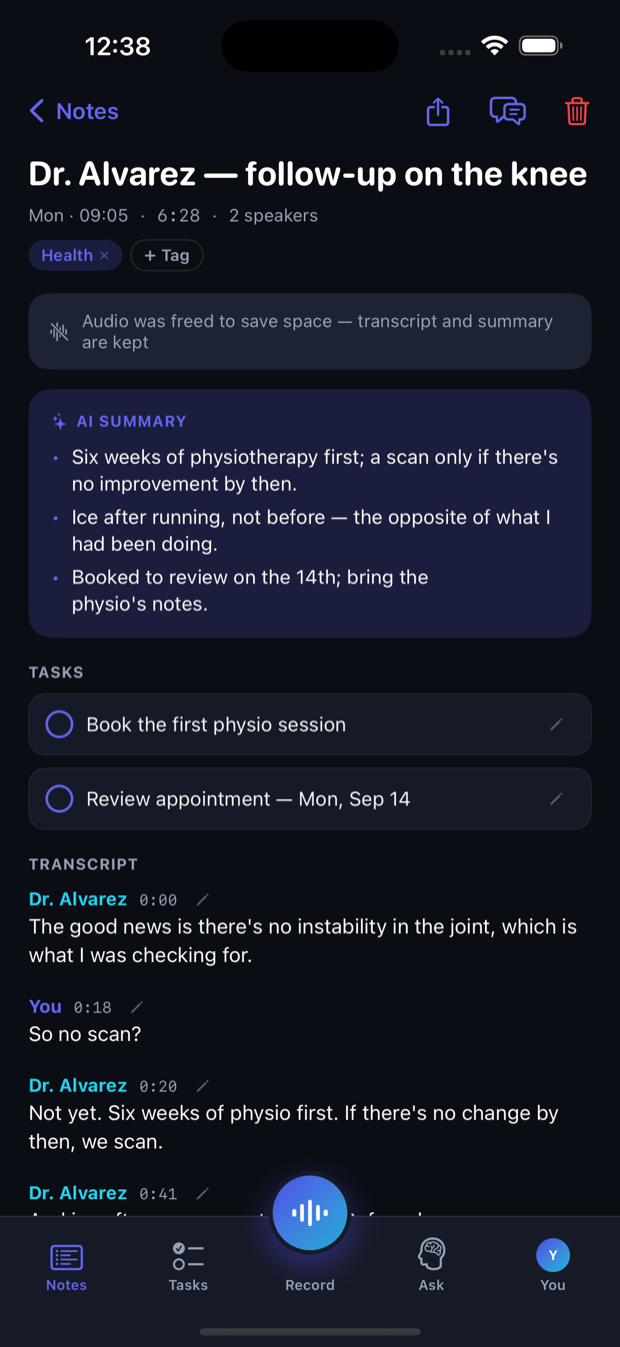
What you want out of a meeting is a short table: who, what, and by when. If your notes tool extracts commitments with their dates automatically, this stops being a writing job and becomes a checking job — you are confirming a list rather than authoring one.
Why speaker labels matter more than they seem
A transcript that does not say who spoke turns every disagreement into an argument about what was agreed. A transcript with speaker labels answers "who said they would do it" directly.
This is the one place where a recorder that only does plain transcription falls short. For meetings, look for conversation or meeting mode with speaker detection, and expect that feature to require sending the audio for processing — telling voices apart is not something a phone does well on its own.
A note on consent
Recording law varies by country and by state, and in many places everyone in the conversation has to agree. Saying "I am recording this so I can write it up afterwards" at the top of a call is both the legal path and, in practice, an easy one — people mind far less than you expect, because they would rather you listened than typed.