
Why the systems keep collapsing
Folders, tags, a weekly review, a capture habit: the advice assumes that the organising is the easy part and the thinking is the hard part. For a lot of people it is the other way round. The thought is there, fully formed, and gone by the time the app is open and the right notebook chosen.
So the system works for a fortnight, the backlog of unsorted notes grows, and eventually the app becomes a place where things go to be forgotten with extra steps.
What changes when the only job is talking
- One tap and you are recording. Say it the way it comes out — half-sentences, tangents, the thing you meant to add. Saymory writes the tidy version.
- The thing you promised — "call the dentist Thursday", "send Sam the file" — is pulled out as a task with its date, and can remind you before it is due.
- There is nothing to file. Notes are searchable, taggable if you like, and the memory works whether or not you ever touch them again.
- A daily or weekly digest tells you what you captured and what is still open, so nothing depends on you remembering to check.
It has to come back to you
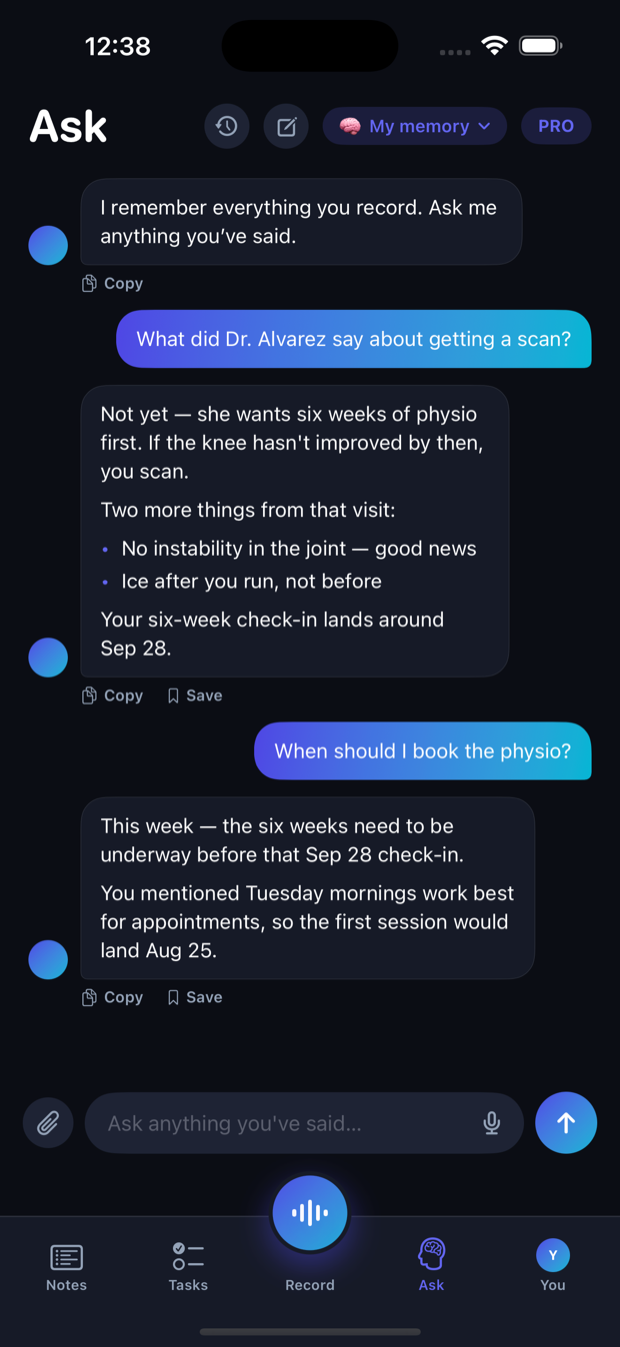
Capture is only half of memory. The other half is retrieval, and retrieval is where filing systems fail people who never filed. Saymory answers questions the way memory does: "what did I decide about the flat", "what was the name of that book" — and shows the note it drew on, so the answer can be trusted.
Keep work and home in separate memories if you want the line, or throw everything in one and let the questions sort it out.
An honest caveat
Saymory is a memory aid, not a treatment, and it does not diagnose anything. It was built for people who forget things — with ADHD, or just with a full life — and it helps to the extent that talking to it is easier than the alternative. For most of the people it was built for, it is.
Questions people ask
Do I have to organise anything?
No. There are no folders and no inbox to clear. Notes are written up as they arrive, tasks are pulled out on their own, and search and questions work over everything. Tags exist for people who want them and cost nothing to ignore.
What if I forget the app exists?
The digest comes to you: a short notification, daily or weekly, with what you captured and what is still open. Reminders on tasks fire whether or not you have opened the app that day. The app does the remembering; that is the point of it.
Is my rambling safe?
The audio is turned into text and then deleted from the transcription provider; nothing is kept there and nothing is used to train models. Your notes stay off our servers unless you switch backup on. You can lock the app behind your fingerprint or face.
Is it free?
Free to start. A new account gets welcome credits for transcription, summaries and questions — enough to find out whether talking works for you. Pro continues from there. Whatever you captured stays yours.