Note taking with ADHD: why systems collapse, and what survives
Most note-taking advice assumes you will maintain a system. If you have ADHD, that assumption is the problem. What actually works when capture has to cost nothing.
The advice everyone gives, and why it fails
Pick a system. Set up folders. Tag consistently. Review weekly. This advice is not wrong exactly — it works for people who were going to be fine anyway. It fails for ADHD brains for a specific, mechanical reason: every one of those steps is a decision, and decisions at the moment of capture are where the thought dies.
The sequence is familiar. You have a thought worth keeping. You open the app. It asks which notebook. You hesitate. Something else takes your attention. The thought is gone, and so is the app — three weeks later you have a beautiful empty system and the private conclusion that you are bad at this.
You are not bad at it. The tool asked you to do executive-function work at exactly the moment you had none to spare.
What is actually going wrong
- Working memory is short, so a thought has to be captured in seconds or not at all
- Task initiation is expensive, so anything with setup cost gets skipped even when you want to do it
- Time blindness makes "I will write it up later" a promise the brain cannot keep
- Out of sight is genuinely out of mind, so a note you have to remember to reread does not exist
- Interest-based attention means the boring maintenance step will lose to literally anything else
The rule that changes the outcome
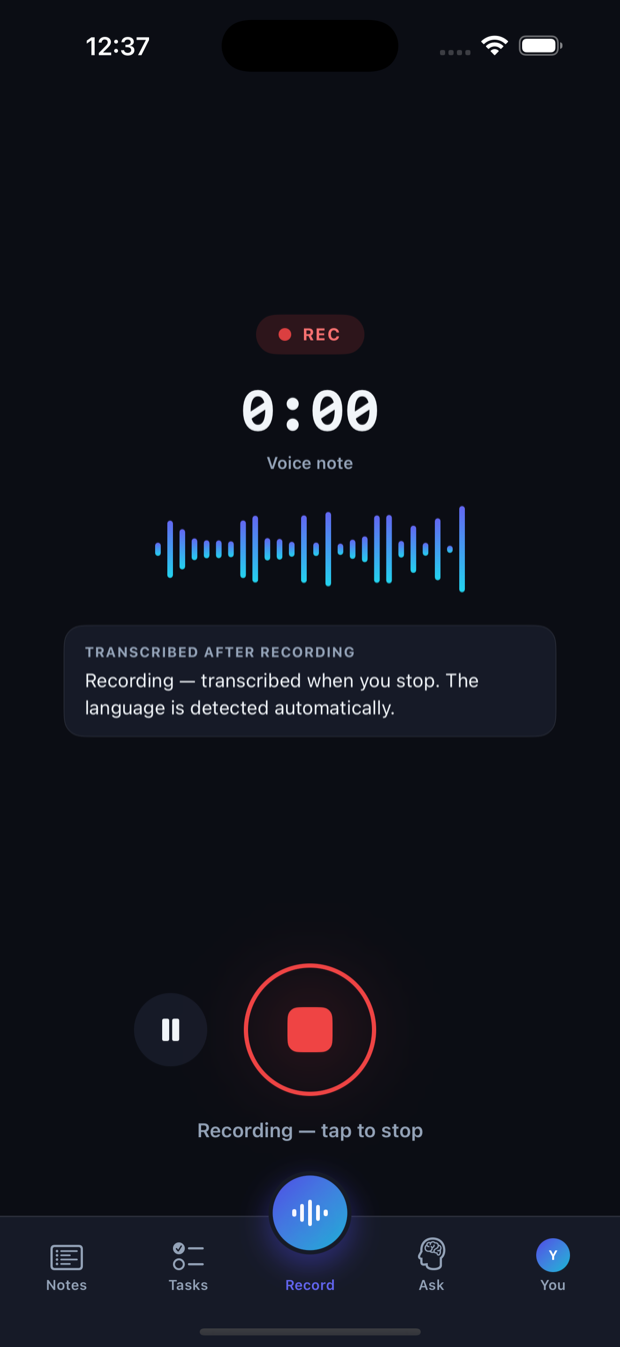
Capture must cost nothing. Not "be quick" — cost nothing. No decision, no destination, no formatting. If the only action is to talk for ten seconds, the thought survives; if there is a menu first, it does not.
This is why voice works so well for a lot of people with ADHD. Speaking is faster than the thought, so you can empty a head that is running ahead of you. Typing is slower, and the gap is where things fall out.
The second rule: organising cannot be your job
If capture is free but filing is manual, you have simply moved the collapse later. Within a month you have two hundred untitled recordings and no idea which one has the thing you need.
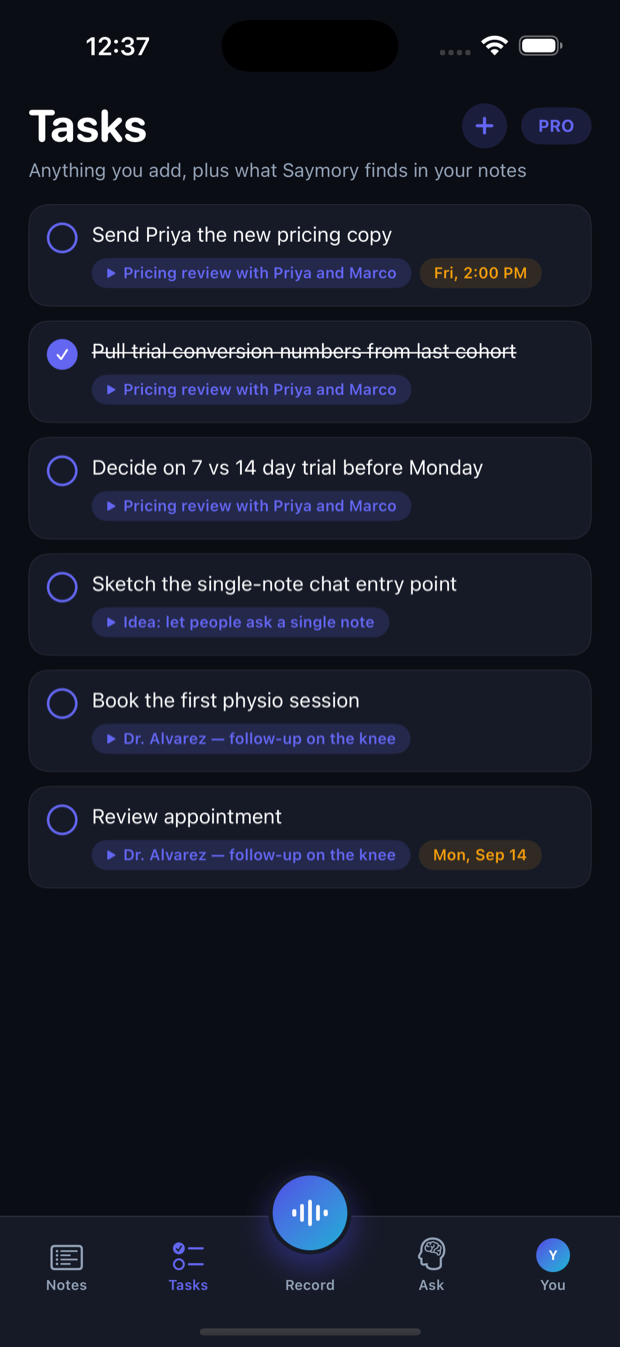
So the write-up has to happen without you: a title from what was said, the points that mattered, and — critically — the commitment pulled out with a date attached. "Call the electrician before Friday" should become a dated task without you deciding it is one.
The third rule: it has to come back to you
Out of sight is out of mind, which means a perfect archive you never open is worth nothing. Something has to resurface: a daily or weekly recap of what you captured, and reminders for the things you said you would do.
This is the step most note apps do not do at all. They will store anything you give them and then wait, silently, forever.
Retrieval should work like memory, not like a filing cabinet
You will not remember which note holds the answer. You will remember that you talked about it. So the useful question is the vague one — "what did the doctor say about the scan?" — and the tool has to handle that rather than requiring the right keyword.
When retrieval works that way, forgetting stops being expensive. You do not have to hold it; you have to have said it once.
An honest caveat
None of this is treatment, and no app is. ADHD is a clinical condition and the people who help with it are clinicians. What a tool can do is remove one specific failure — the gap between having a thought and keeping it — which happens to be a gap that costs a lot of people a lot of trouble.
Saymory was built around these three rules: talk to capture, let it do the write-up, and ask it questions later. It is a memory aid for busy, forgetful heads. If it removes one dropped commitment a week, it has done its job.
A week-long experiment
Do not build a system. For one week, every time you catch yourself thinking "I should remember that", say it out loud into your phone instead. Do not organise any of it. At the end of the week, ask it what you said.
If the answers are useful, you have found the shape that works for you. If they are not, you have lost a week of talking to yourself — which, for most people reading this, is a normal Tuesday anyway.