What is a second brain, and how do you actually keep one?
A plain explanation of the second brain idea, why most systems collapse within a month, and what a version that survives real life looks like.
The idea in one sentence
A second brain is an external store of what you know and what you have committed to, arranged so you can retrieve it later without having remembered it in the first place.
The phrase was popularised by Tiago Forte, and the usual framing is a note-taking method: capture things, organise them into categories, distil them, express them. That framing is sound. It is also where most people fall off.
Why most second brain systems fail
Almost every system asks you to do work at the moment of capture. Pick a folder. Add tags. Decide whether this is a project, an area, a resource, or an archive. Each decision is small and each one is a place to stall — and stalling at capture means the thought is simply lost.
The systems that survive share one property: capture costs nothing. If you have to think about where something goes before you can write it down, you will stop writing things down within about three weeks. This is not a discipline problem. It is a design problem.
Capture, organise, retrieve — and which one actually matters
The three jobs of a second brain are not equally hard. Capture has to be effortless or it does not happen. Organising is work nobody enjoys and most people do badly. Retrieval is the entire point and the part almost every system handles worst — a note you cannot find is indistinguishable from a note you never took.
The useful conclusion is that organising should be automatic, and retrieval should work the way memory works: you ask a vague question and get a specific answer. You do not remember the filename of a thought. You remember that you once discussed it.
What a second brain looks like when it is working
- You capture by talking, in ten seconds, without opening a folder or choosing a tag
- The write-up happens without you — a title, the points that mattered, and what you agreed to do
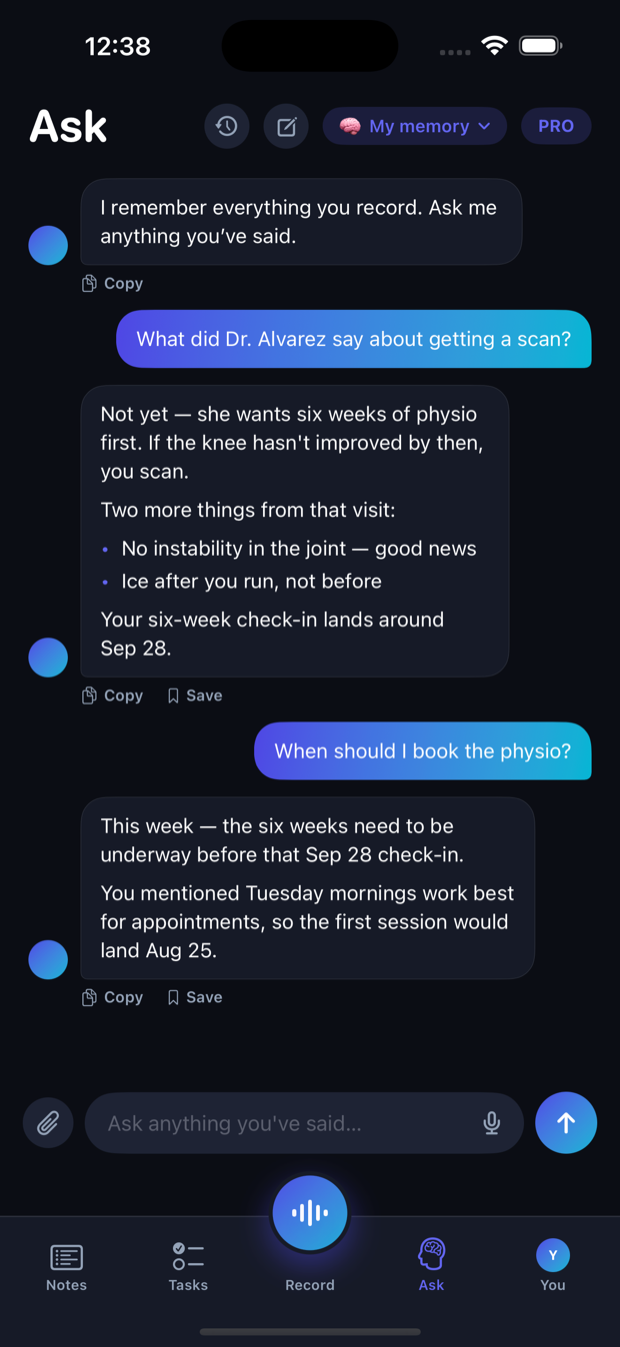
- Commitments get dates and come back to you before they are late, rather than waiting to be rediscovered
- You retrieve by asking a question in ordinary words, and the answer arrives with its source so you can verify it
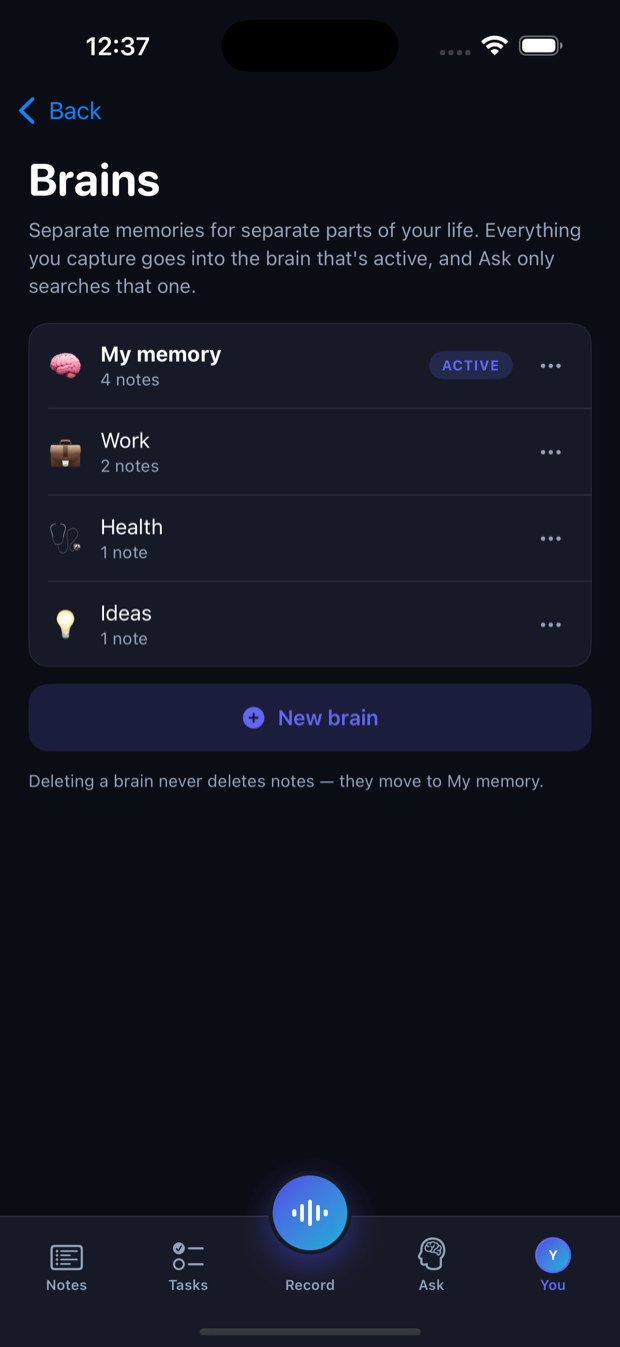
- Separate parts of your life stay separate — asking about work does not surface last year's medical appointments
Who this helps most
People whose thoughts move faster than their notes. That includes plenty of people with ADHD, and plenty of people who simply have too much going on — the failure mode is identical either way: the thought was there, and by the time there was a moment to write it down, it was gone.
For that pattern, the traditional advice to "build a system and maintain it" is exactly backwards. The system has to maintain itself, or it will not be there when you need it. A second brain is a memory aid, not a productivity religion, and definitely not medical treatment — but for a forgetful head it is the difference between a commitment kept and a commitment discovered too late.
Starting without a method
You do not need to read a book to start. For a week, every time you would normally think "I should write that down", say it out loud into your phone instead and let something else do the filing. At the end of the week, ask it what you said.
If the answers come back useful, you have a second brain. The method can come later, if you still want one.