Choosing an AI note taking app: what actually matters
AI note taking apps all promise the same three features. The differences that matter are privacy, whether recording survives the background, and whether you can ask your notes anything.
Every app in this category claims the same three things
Record, transcribe, summarise. Read a dozen listings and the feature lists are nearly interchangeable, which makes them useless for choosing.
The questions worth asking are the ones the listings do not answer.
Where does the audio go?
This is the biggest genuine difference between apps in this category, and it is rarely stated plainly. Most transcription runs in the cloud, which means your recordings are uploaded and stored on someone else's servers.
On modern iPhones, ordinary speech recognition can run on the device, which means an app can transcribe a voice note without the audio going anywhere. Check whether the app you are considering does this, whether it is the default, and what specifically triggers an upload.
Does the recording survive a real hour?
A surprising number of recording apps fail in the background. The phone locks, another app takes the microphone, a call comes in, iOS reclaims memory — and the recording quietly stops, or the file is corrupted when you come back.
You will not discover this in a two-minute test. Test the app the way you will use it: start a recording, lock the phone, use other apps, take a call, and come back an hour later. Whether the audio is intact is worth more than any feature on the listing.
Can you get an answer, or only a document?
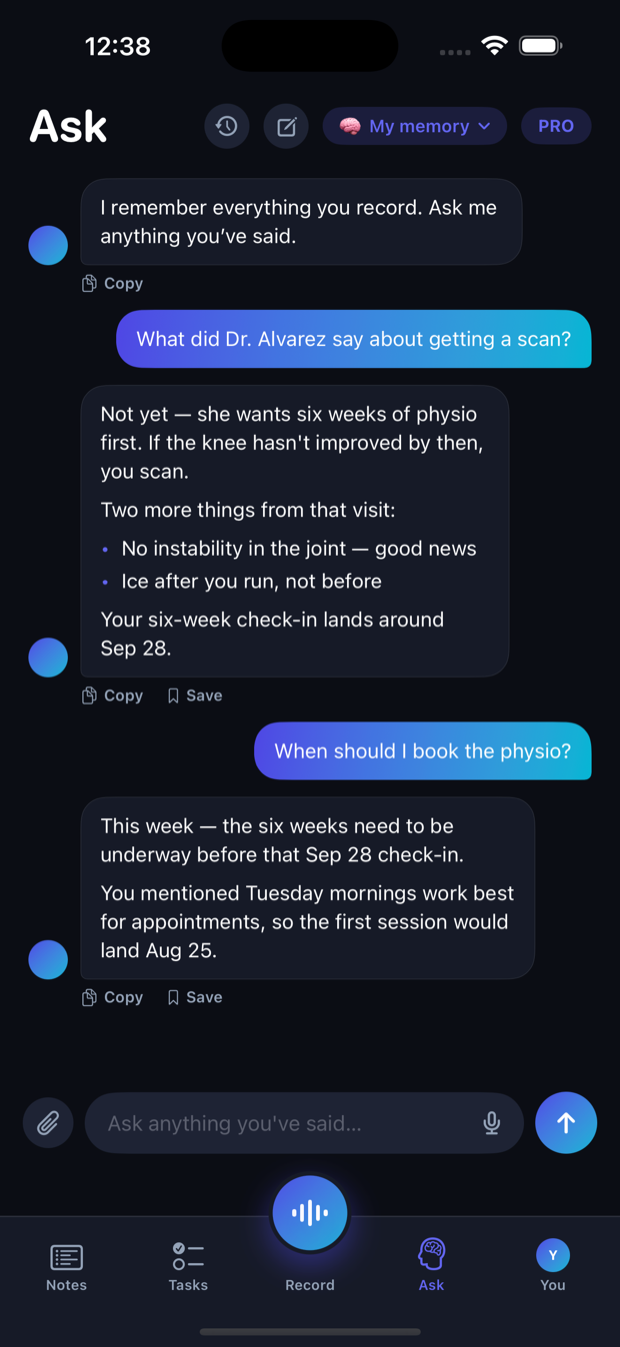
A summary is useful once, on the day. The value of months of notes is retrieval — and the difference between an app that stores your notes and one that answers questions from them is the difference between a filing cabinet and a memory.
If an app can answer "what did we agree the budget was" and show you the moment it came from, it is doing something categorically different from producing a document you will never reopen.
The unglamorous checklist
- What happens to your notes if you stop paying — export, or hostage?
- Are notes tied to your account, so a shared phone does not mean shared notes?
- Is the transcript editable when the recogniser gets a name wrong?
- Does it work with no signal?
- Does it handle the languages you actually speak?
Where Saymory sits
Saymory transcribes ordinary voice notes on the device, keeps recordings on your phone unless you turn on encrypted backup, writes the summary and pulls out commitments with their dates, and lets you ask questions across everything you have recorded — with the source recording attached to the answer.
It was built for people who forget things: no folders to maintain, no system to keep up with, and capture that costs one tap.